

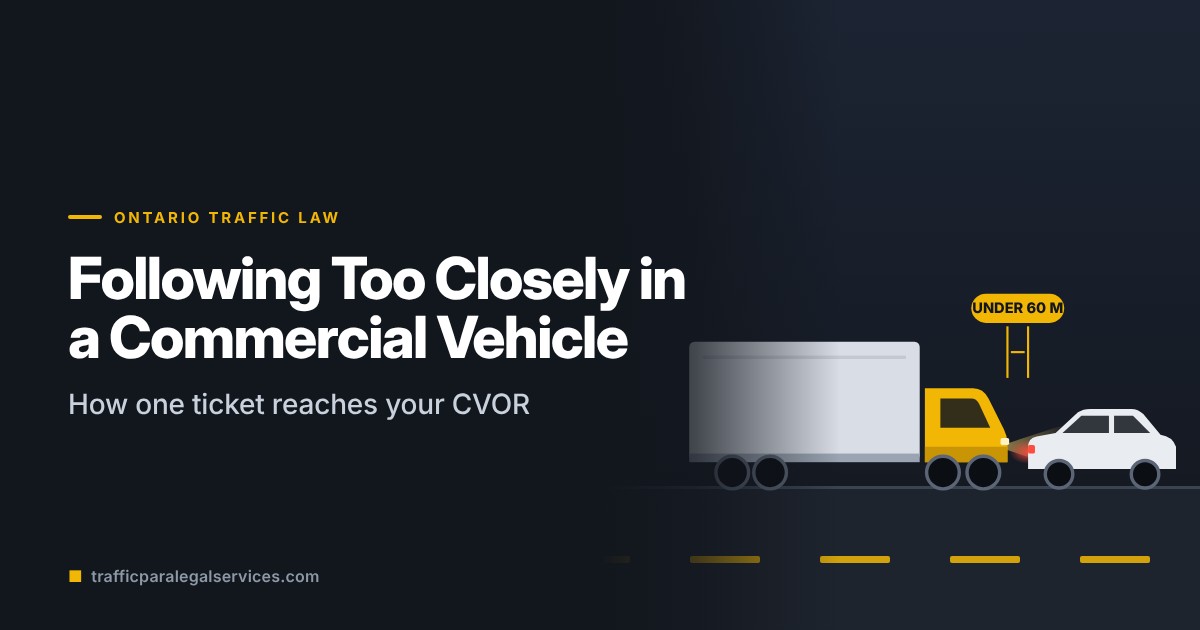
It’s raining on the 401 westbound past Milton, a little after six in the morning, and a driver hauling a dry van is doing about 95 in the right lane. A hatchback merges in front of him from the on-ramp, he eases off the throttle, and before the gap has opened back up there’s an OPP cruiser behind him with its lights on. Five minutes later, parked on the wet shoulder, he’s holding a ticket for following too closely.
Most drivers look at a ticket like that and think about the obvious costs. There’s a fine, there are four demerit points on the licence, and maybe the insurance goes up at renewal. For someone driving their own car to work, that’s more or less where it ends.
In a commercial vehicle it doesn’t end there, because the conviction can also land on the operator’s CVOR record, the safety file the Ministry of Transportation keeps on carriers in Ontario. The page at https://www.trafficparalegalservices.com/cvor-tickets/ goes through the kinds of CVOR tickets drivers and fleets deal with, and it’s worth knowing how a single following too closely charge fits into that picture before deciding to just pay it.
What section 158 says
Following too closely falls under section 158 of Ontario’s Highway Traffic Act. Subsection 158(1) applies to everyone and is deliberately loose: you shouldn’t follow another vehicle more closely than is reasonable and prudent, given the speed, the traffic and the condition of the road. There’s no fixed distance written into it, which leaves a great deal to the officer’s judgement on the day.
Subsection 158(2) is the one aimed at trucks. A commercial motor vehicle travelling on a highway above 60 km/h has to keep at least 60 metres from the vehicle ahead, with an exception for overtaking and passing. Sixty metres is a little under three tractor-trailers laid end to end, and anyone who has driven the 401 through Mississauga at rush hour knows how often a car slides straight into that space.
Same ticket, different consequences
| Personal vehicle | Commercial vehicle | |
|---|---|---|
| Distance rule | Reasonable and prudent | At least 60 m above 60 km/h |
| Demerit points | 4 | 4 |
| Fine range | $60 to $500 | $60 to $500 |
| CVOR record | Not affected | Conviction can be recorded |
| Work impact | Rarely | Can come up in hiring and reviews |
On the driver’s own record, demerit points stay for two years from the date of the offence, while the conviction itself shows on a three-year driver’s abstract. That abstract is the document employers and insurance brokers actually ask for, so a ticket paid in a hurry in March can still be sitting there when you apply somewhere new two winters later.
Why the CVOR side matters more
The CVOR record tracks a carrier’s convictions, collisions and roadside inspections. The Ministry measures that record against a threshold based on things like fleet size and how far the trucks travel, so there’s no single number of tickets that causes trouble. As the record gets worse, MTO can send a warning letter, order a facility audit, call the company in for an interview or, at the far end, suspend the registration altogether. According to Traffic Paralegal Services, the points stay on the record for a minimum of two years.
For an owner-operator running under their own CVOR, every conviction goes straight onto their own file. For a company driver, a few tickets can drag on the fleet’s standing, which is partly why plenty of carriers look closely at a driver’s abstract before hiring and again when insurance comes up for renewal.
Your options once you have the ticket
An Ontario offence notice gives you 15 days to choose what to do. Paying the fine is the first option, and probably the one people regret most often, since paying counts as a guilty plea and the conviction is registered straight away. The second, available at many court locations, is an early resolution meeting with the prosecutor, where a charge can sometimes be reduced to something with lighter consequences. The third is asking for a trial, where the prosecution has to prove the distance wasn’t safe, usually on the strength of the officer’s estimate from wherever the cruiser happened to be sitting.
That estimate is often the weakest part of the case. Judging 40 or 50 metres between two moving vehicles, in spray, from a car three lanes over, is harder than it sounds, and a paralegal will want to know exactly how the officer arrived at the number.
Details worth writing down after the stop
Memories fade fast, and these are the kinds of things that come up months later in court.
- The time and exact location.
- Weather and road surface.
- How heavy the traffic was.
- Whether a vehicle cut in ahead.
- Where the cruiser was positioned.
- Any dash cam footage, saved somewhere safe.
Dash cam footage in particular tends to get overwritten within a day or two on most units, so pull the clip off the card the same evening if you can.
Getting help with the charge
Licensed paralegals in Ontario can represent drivers in provincial offences court, and for anyone driving commercially it usually makes sense to have someone look at the ticket before the 15 days run out. Traffic Paralegal Services, based in Caledon East, has been handling traffic matters across Ontario for more than 15 years, and its paralegals are licensed by the Law Society of Ontario.
If the ticket in your hand is for following too closely, https://www.trafficparalegalservices.com/following-too-closely/ explains how the firm approaches that particular charge, including reviewing the officer’s notes and any video evidence before deciding whether to negotiate or take it to trial.
Not every ticket can be beaten, and nobody honest will promise that it can. A following too closely charge is still worth a second look before you pay it, especially when your income depends on the licence in your wallet and the CVOR behind it.